
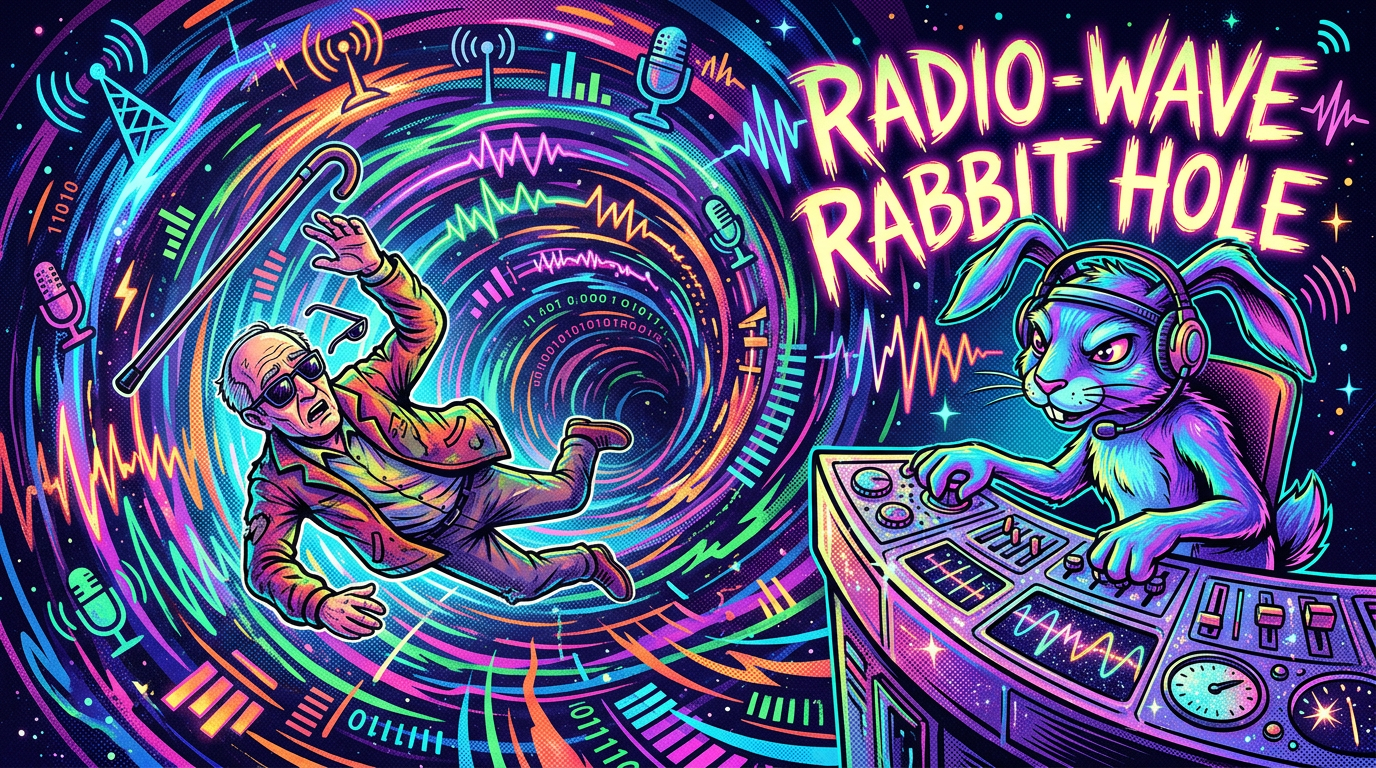
If you read my Prime Day post, then you may remember that I briefly mentioned the General Mobile Radio Service, or GMRS. I promised I’d write more about it later. As it turns out, “later” became “after spending several hours reading FCC regulations.”
This happens to me more often than I’d like to admit.
I have a question. I Google it. That answer raises another question, so I Google that. Before I know it, I’ve spent an entire afternoon down a rabbit hole that I never intended to explore.
This time, the rabbit hole was 47 CFR Part 95 – Personal Radio Services. That’s the part of the FCC rules that governs all of the radio services ordinary people can use without becoming licensed amateur radio operators.
I learned far more than I expected to, and I thought some of it was worth sharing because it might be useful to my fellow people who enjoy knowing things about things.
Keep reading if you’d like to:
- Understand the differences between the three major license-free two-way radio services, plus a fourth that might be worth thirty-five dollars.
- Learn where those assisted listening devices and audio description headsets in theaters actually operate.
- Find out what a GMRS license gets you and why I decided to buy one.
- Understand what a repeater is and why bigger antennas really do make a difference.
- See how ham radio differs from all of these services.
- Maybe, just maybe, discover a new hobby.
Which Radio Service Should You Use?
If you’re just looking for the answer instead of the journey, here’s the short version.
- CB is for nostalgia, truckers, and people who don’t mind a little chaos.
- MURS is great for job sites, farms, large properties, and anyone who wants a little more range than inexpensive walkie-talkies.
- FRS is perfect for families going to the zoo, camping, hiking, or trying not to lose each other at the county fair.
- GMRS is for families who want more range, better equipment, and the ability to use repeaters that can cover an entire city.
- Ham radio is what happens when using radios stops being the goal and learning everything about radio becomes the hobby.
Now let’s talk about each one.
Citizens Band: The Wild West of Radio
If you’re old enough to remember the 1970s or 1980s, you almost certainly know what Citizens Band Radio, or CB, is. Truckers made it famous. Movies made it cool. Kids like me spent hours in conversations we probably shouldn’t have been hearing or having.
CB operates around 27 MHz using AM, the same type of modulation traditional AM broadcast radio uses, along with an optional mode called Single Sideband, or SSB. You don’t need a license. You don’t even have to register with the FCC. If you buy a certified CB radio and follow the rules, you’re allowed to use it.
The FCC’s rules are actually pretty straightforward. Keep your radio within the legal power limits, don’t modify it to transmit more power than it’s designed for, don’t intentionally interfere with other people, don’t use it to harass anyone, and remember that Channel 9 is reserved for emergency communications. The rules also make it clear that CB is intended as a local communications service, not a way to have conversations halfway across the continent.
That last part is where things get entertaining.
The 27 MHz band has a habit of doing things the rule makers wish it wouldn’t.
Every eleven years or so, the Sun becomes especially active. During those periods, and sometimes even outside of them, the Earth’s ionosphere becomes very good at reflecting radio waves back toward the ground. Radio operators call this “skip.”
Instead of your signal traveling a few miles to someone across town, it suddenly bounces hundreds or even thousands of miles away.
The FCC doesn’t want CB used for those long-distance contacts. It’s supposed to be for local communication. The problem is that radio waves don’t read the rulebook.
Neither do many CB operators.
Once the band opens up, every channel becomes a wall of voices from all over North America. Add in plenty of operators using illegal high-power amplifiers, people keying up just to whistle or make strange noises, and plenty of stations outside the United States that aren’t subject to FCC rules, and you’ve got absolute bedlam.
If you’ve never heard it, imagine trying to have a conversation in a crowded sports bar while everyone else is simultaneously trying to win a shouting contest.
That’s CB on a good day.
The other challenge is the antenna.
Radio antennas work best when they’re proportional to the wavelength they’re transmitting. Since 27 MHz has a relatively long wavelength, a practical CB antenna is also fairly long. A decent mobile antenna is around four feet. An excellent one is closer to eight.
That’s perfectly reasonable on the roof of a pickup truck.
It’s considerably less practical on a handheld radio unless your goal is to poke someone’s eye out.
I learned firsthand just how well CB can travel when I was about fifteen years old. I had a four-watt CB radio connected to a four-foot magnetic mount antenna that was stuck to a piece of sheet metal outside my bedroom window.
One evening the band opened up.
I ended up talking to someone in England.
At the time I thought it was the coolest thing ever.
Years later I discovered that the FCC probably wouldn’t have shared my enthusiasm.
So, in summary, CB is loud, unpredictable, occasionally frustrating, frequently hilarious, and still a lot of fun if you go into it with the right expectations.
MURS: The Quiet Professional
If CB is the loud guy telling stories at the bar, the Multi-Use Radio Service, or MURS, is the quiet professional who actually gets things done.
MURS operates on five channels in the VHF portion of the radio spectrum around 151 and 154 MHz. Those frequencies travel differently than CB. They don’t usually bounce around the world, but they do tend to travel a little farther than the inexpensive Family Radio Service walkie-talkies most people buy.
You don’t need a license to use MURS, either.
The FCC limits MURS to relatively low power, requires certified MURS radios, and prohibits using repeaters to extend your range. The idea is simple, local communications between people who need reliable radios without creating interference over huge distances.
Unlike FRS radios, MURS equipment is allowed to have removable antennas. That’s a surprisingly big advantage. If you’re using a radio at home or on a farm, being able to connect a better antenna mounted higher up can make a noticeable difference in how well you hear and how well you’re heard, even without increasing power.
MURS has become popular with construction crews, maintenance workers, warehouses, schools, churches, farms, and anyone else who needs dependable short-range communications without paying monthly fees to a cellular provider.
If you’ve wandered through Home Depot or another home improvement store and noticed rugged handheld radios for sale, there’s a decent chance you’ve seen MURS radios without realizing it.
One interesting bit of history: before MURS existed, many of these frequencies required individual FCC licenses. When the service was created, existing licensees were allowed to keep operating under certain grandfathering provisions. Everyone else simply got the benefit of being able to buy a radio and start talking without filing paperwork.
It isn’t nearly as famous as CB.
It isn’t nearly as cheap as FRS.
It also isn’t nearly as chaotic as either of them.
Sometimes boring is exactly what you want.
FRS: The Walkie-Talkies Almost Everyone Has Used
If you’ve ever gone camping, visited an amusement park, or tried to keep track of a group of kids at the zoo, you’ve probably used the Family Radio Service, or FRS.
This is the radio service most people think of when they hear the words “walkie-talkie.”
FRS shares some of its channels with GMRS, which is one reason there’s so much confusion about the two services. The good news is that, yes, they’re designed to work together. Someone using an FRS radio can legally talk to someone using a GMRS radio, provided they’re both using one of the shared channels.
The difference is mostly in the equipment.
The FCC designed FRS to be as simple as possible. The radios are all handheld. The antennas are permanently attached. You can’t swap them out for bigger ones, hook them up to a rooftop antenna, or connect them to a repeater. Power levels are intentionally kept fairly low so that everyone can share the channels without interfering with people miles away.
That’s also why you’ll find FRS radios almost everywhere. Sporting goods stores sell them. Big box stores sell them. Online retailers sell them. You can buy a pair for way less than the cost of taking your family out to see Toy Story V.
Manufacturers love advertising ridiculous range claims like “Up to 36 Miles!”
Technically, they’re not lying.
If one person is standing on one mountaintop, another person is standing on another mountaintop, there’s nothing in between them except air, and it’s not raining, you might actually get close.
Back here on Earth, though, where there are buildings, trees, hills, cars, and other inconvenient objects, a much shorter range is a far more realistic expectation. My six-year-old son and I get a couple of blocks around the neighborhood.
That’s not a criticism.
It’s exactly what FRS was designed to do.
For keeping your family together during a day out, coordinating with another car on a road trip, or letting your kids call you from the park, FRS works remarkably well.
In fact, that’s one of the reasons I became interested in GMRS.
GMRS: The Family Radio Service’s Bigger, Cooler Sibling
I’ve known about the General Mobile Radio Service, or GMRS, for decades.
For most of that time, though, it seemed like something very few people actually used and I didn’t know why I should care.
Then I got back into ham radio.
Suddenly everyone seemed to be talking about GMRS.
I started asking why.
The answer turned out to be surprisingly simple.
The FCC reduced the license fee to thirty-five dollars, extended the license term to ten years, and made the application process almost straightforward. Since I already had an FCC account because of my amateur radio license, I logged in, filled out the application, paid the fee, and waited.
The next day I received an email.
I was officially licensed.
My new GMRS callsign is WSNH893.
Unlike FRS, GMRS does require a license, but there’s no exam. If you’re legally eligible to hold an FCC license, fill out the application, and pay the fee, you’re probably going to receive one.
Even better, the license doesn’t just cover you.
It also covers your immediate family. Your spouse, children, parents, grandparents, grandchildren, siblings, aunts, uncles, nieces, nephews, and in-laws can all operate under your license without each having to buy one of their own.
That’s a fantastic deal if your family enjoys spending time outdoors or simply wants a dependable way to stay in touch when cell phones aren’t practical.
The equipment is also much more flexible than FRS.
GMRS radios can be handhelds like FRS radios, mobile radios installed in vehicles, or base stations at home. They can use removable antennas. Many models transmit at considerably higher power than FRS radios.
The biggest advantage, though, is repeaters.
A repeater is exactly what its name suggests.
Imagine two people trying to talk to each other from opposite sides of town. Their handheld radios probably can’t reach each other directly.
Now imagine a radio receiver sitting on top of a thousand-foot tower.
When your handheld transmits, that receiver hears your signal. It simultaneously retransmits what you said using its own transmitter, a much bigger antenna, and substantially more power than your handheld radio could ever use.
Instead of talking a mile or two, you may suddenly be talking across an entire metropolitan area.
That’s why repeaters are such a big deal.
They’re one of the reasons GMRS has become so popular in recent years.
The FCC does allow GMRS stations to use considerably more power than FRS, although the exact limit depends on which channels you’re using and what type of station you’re operating. For most people, the important takeaway is simply this: GMRS gives you more flexibility, more range, and better equipment options than FRS while still being far easier to get into than amateur radio.
For me, the biggest selling point is my kids.
My six-year-old loves being able to take a radio to the park and call Dad whenever he wants.
Cell phones are wonderful.
Handing a six-year-old an expensive smartphone so I can tell him it’s time to come home?
Hell no!
A sturdy handheld radio, on the other hand, is almost perfect.
And because we now have a GMRS license, we have room to grow. We can start with simple handheld radios today and eventually add better antennas, mobile radios in our cars, (my 15-year-old is learning to drive, y’all), or even put up a repeater if we decide we need more range.
Oh, and if you’re wondering whether antenna size matters…
Yeah.
It turns out size really does matter.
At least when we’re talking about radio.
So Why Ham Radio?
At this point you might be wondering why anyone bothers getting an amateur radio license.
After all, GMRS sounds pretty great.
It is.
Ham radio is simply something different.
GMRS is a communications service.
Amateur radio is a hobby.
To become a ham, you have to pass an exam that demonstrates you understand basic radio theory, operating practices, and FCC regulations. You still pay the FCC’s thirty-five-dollar application fee once you’re licensed, but earning the license requires learning something first.
The reward is access to an enormous collection of radio frequencies stretching from the low-frequency bands all the way into the microwave spectrum. Depending on the band you’re using, you may be allowed to transmit with as much as 1,500 watts of power. You can communicate through satellites, bounce signals off the Moon, send television pictures over the air, exchange digital messages around the world, build your own equipment, experiment with antennas, help provide emergency communications, and generally discover just how weirdly fascinating radio can be.
In other words, GMRS lets you communicate.
Ham radio lets you explore.
Personally, I think everyone should spend at least a little time exploring.
The Other Things I Discovered While Falling Down the Rabbit Hole
I promised you a little more than just CB, MURS, FRS, and GMRS.
It turns out Part 95 covers all kinds of radio services that most people have never heard of. Some are surprisingly useful. Others are just plain cool.
The Radio Control Radio Service
First up is the Radio Control Radio Service, or RCRS.
This one exists for exactly what it sounds like: controlling things remotely by radio.
Years ago, if you bought a radio-controlled car, boat, or airplane, there was a good chance it operated under these rules. Today, most hobby equipment has moved to newer technologies in different parts of the radio spectrum, but the service still exists.
Unless you’re restoring vintage radio-controlled equipment or you’re simply fascinated by radio history, you’ll probably never use it.
Still, I think it’s neat that the FCC carved out an entire radio service just so people could make toy airplanes fly around.
The Low Power Radio Service
This was probably the biggest surprise for me.
The Low Power Radio Service, or LPRS, isn’t really intended for conversations between people. Instead, it’s designed for short-range devices that need to send information without wires.
That includes things like medical telemetry, industrial equipment, and—this is the part that got my attention—assistive listening systems and audio description transmitters used in theaters, museums, churches, and similar venues.
If you’ve ever borrowed a headset at a movie theater to hear audio description, or if you’re deaf or hard of hearing and have used an assisted listening receiver, there’s a good chance you were listening to an LPRS transmitter.
Here’s the interesting part.
Many of those systems use ordinary analog FM radio. If they do, you may be able to receive them with a portable scanner or an amateur radio handheld that includes scanner functionality. Not every system works this way—many newer systems use digital technology or proprietary wireless systems—but enough of them do that it’s worth knowing.
As someone who’s blind, I find this genuinely exciting.
More than once I’ve sat down for a movie only to discover that the receiver handed to me was tuned for assisted listening instead of audio description. That means another trip back to customer service while everyone else is already watching the first act.
If I can program those frequencies into my own scanner ahead of time, I might be able to switch to the correct channel myself without ever leaving my seat.
I’m definitely going to experiment with that.
Yes, There’s Even a Radar Service
Then I stumbled across something that made me squee.
There is an entire section of the rules for radar.
Specifically, Part 95 includes rules for short-range radar devices that operate in the 76 to 81 GHz band.
These aren’t giant weather radars or airport installations.
They’re the kinds of radar systems that help modern vehicles detect obstacles, maintain following distance with adaptive cruise control, avoid collisions, and assist with parking.
The rules also allow similar radar devices to be used in fixed locations and even as portable equipment, provided they’re certified and operated as intended.
I’m blind. A personal radar would have all kinds of uses and be incredibly cool!
If someone invents a head warn radar gadget that detects obstacles and makes me feel like I’m Geordi LaForge from Star Trek, there’s a decent chance I’ll want one.
There’s Even More
Those aren’t the only services covered by Part 95.
The FCC also has rules for:
- Wireless Medical Telemetry Service (WMTS), used by hospitals to monitor patients.
- Medical Device Radiocommunication Service (MedRadio), which lets implanted and wearable medical devices communicate safely.
- Personal Locator Beacons (PLBs), which can summon rescue services during life-threatening emergencies.
- The 218–219 MHz Service, which supports certain fixed and mobile communications applications.
Most of us will never directly use any of those.
Still, I think it’s fascinating that they’re all tucked away in the same section of the FCC rules alongside the walkie-talkies you can buy at Walmart.
Sometimes the rulebook is more interesting than you’d expect.
So… Why Should You Care?
You don’t have to become a radio nerd like me.
You probably shouldn’t spend an afternoon reading FCC regulations unless that’s your idea of a good time.
What I hope you take away from this is that there are more ways to communicate than most people realize.
For families, a few inexpensive FRS radios, (they sell them in ten-packs), might be all you’ll ever need.
If you want more range and flexibility, GMRS is surprisingly affordable and easy to get into.
If you’re curious about electronics, antennas, emergency communications, or simply learning how radio works, amateur radio opens up an entire universe waiting to be explored.
And if you’re blind or deaf, maybe this article helps you discover another way to access assistive technology that you didn’t know existed.
That’s a pretty good outcome for a few hours spent wandering through a government regulation.
What Rabbit Holes Have You Fallen Into?
I seem to have a talent for becoming fascinated by subjects that most people never think about.
Radio just happens to be this week’s example.
What about you?
Have you ever become obsessed with learning about something that started with one innocent question and turned into an afternoon—or a week—of reading?
Tell me in the comments.
If you’re subscribed to the email newsletter, you don’t even have to visit the website. Just reply to the email, and your reply becomes your comment.
And if you enjoyed this article, please share it with your friends, your family, or that random person you strike up a conversation with on public transportation who looks like they could use an entertaining rabbit hole of their own.
As always, thank you for reading, and thank you for sharing.


Leave a Reply