
Listen to this essay
Download the audio version (MP3, 10 minutes 27 seconds)
I arrived fifteen minutes early. My session began nearly forty-five minutes late.
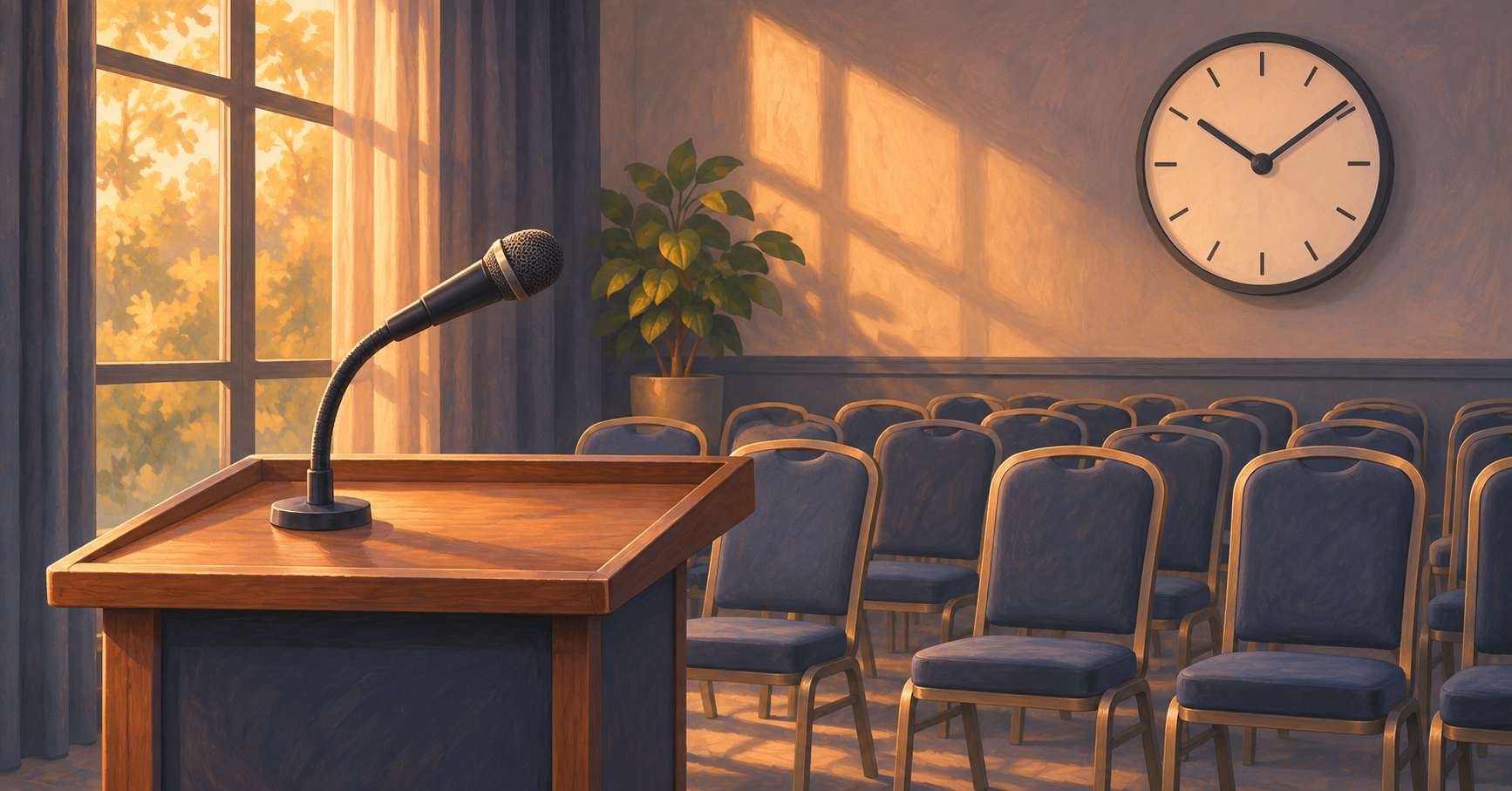
In between, I stood in a convention breakout room with a working microphone, plenty of chairs, and a ninety-minute agenda that was steadily becoming impossible to deliver.
At first, I waited patiently. When the scheduled start time passed, I assumed people would arrive soon. Fifteen minutes later, someone stopped in and said she thought the general session was running long. She could hear applause, so perhaps it was wrapping up.
More time passed. One person came in, sat in the back, and ate chips without responding to my greeting. Another arrived and explained that they planned to move back and forth between my presentation and another one. The person in the back said they intended to do the same. I explained that I might not hold the session if no one planned to stay for it. They left.
Eventually, three people arrived, including the president of the organization hosting the convention. When he asked how I was doing, I politely told him I was frustrated. All three said they intended to stay, and we began.
By then, nearly half of my allotted time was gone. As I worked through a compressed agenda, people continued to come and go. Some were quiet. Others held conversations in the back. One person asked a question I had answered just before they entered. Each interruption made it harder to stay focused and give the people who were listening the session they deserved.
This happened to me at the National Federation of the Blind of Minnesota’s state convention this past weekend. It has stayed with me because it raises a question larger than one frustrating afternoon: How well do we practice the respect we ask others to show us?
Raising expectations includes our own
Six years ago, I founded Penny Forward to provide affordable, accessible financial education to the blind community. Since then, I have been invited to present at conventions hosted by state affiliates of both the National Federation of the Blind and the American Council of the Blind. Many of those experiences have been wonderful, and I have been honored by the continued invitations.
I also believe in the Federation’s call to raise expectations for blind people. We deserve opportunities, professional respect, and the freedom to demonstrate what we can do.
That principle asks something of us, too. We need to treat one another’s work, preparation, and time as valuable. We should bring the same professionalism to our own events that we expect in other professional settings.
I left this convention feeling that my time and preparation had not been respected. I have experienced similar scheduling problems at both NFB and ACB conventions, so I see a concern that extends beyond one affiliate or organization. I have also encountered people moving between presentations outside the blindness community. We all have reason to examine how our choices affect the people around us.
A schedule is a promise to everyone in the room
When a convention publishes a start time, presenters and attendees organize their day around it. A presenter may have another commitment afterward. An attendee may need to catch a ride. The next speaker may need the same room. A late start can take time away from all of them.
I had a tight schedule that day. Staying late to deliver the rest of my presentation was not an option. Once those minutes were gone, I could only decide what to leave out.
Convention leaders have to protect the whole program, including the sessions that follow their own. That may mean limiting questions, shortening an announcement, postponing a door prize, or asking a speaker to finish. It also means ending their own remarks on time. Those decisions can be uncomfortable. They are part of respecting everyone who has made plans around the agenda.
When a delay is unavoidable, presenters and attendees need clear information about what has changed. Waiting alone in a room, wondering whether anyone is coming, should not be the way a presenter learns that the schedule has slipped.
Choosing a session means giving it your attention
There were two other events competing with mine. My friend Kaity Shelton was facilitating a Tactile Art Collective event whose description explicitly invited people to drop in briefly or stay for the whole time. Moving in and out fit that event’s format.
Anil Lewis was leading a session on mentoring conversations. I have met Anil several times and heard him speak. I understand why someone would want to attend his session. I would never question someone’s decision to choose it over mine.
A convention full of worthwhile options requires choices. When I want to attend two presentations, I choose one and give it my attention. I miss something else, but I gain the chance to follow an idea, participate in a conversation, and get the full value of the session I chose.
Repeatedly moving between sessions can feel like a way to support both presenters. From the front of the room, it can mean repeated interruptions, questions whose context has been missed, and a discussion that never quite has a settled group. The cost falls on the presenter and everyone trying to listen.
I cannot speak for Anil or Kaity about how they feel. I can say that each of us deserves consideration, and that the advertised format matters. A drop-in activity welcomes movement. A presentation or facilitated discussion asks for a different kind of participation.
People also need to leave for bathrooms, health needs, fatigue, and other reasons. Finding an unfamiliar room can take time, and a phone may be someone’s access tool. We should make room for those realities. We can do that while asking people to minimize avoidable disruption and make thoughtful choices about the sessions they attend.
The courtesies I try to practice
I do not always get everything right. Sometimes I am late because I cannot find a room or because the bathroom line is longer than I expected. Still, I try to make my presence considerate of the people around me:
- I aim to arrive on time. If I am late, I enter quietly and take a seat with as little interruption as possible. If I need a moment to find one, I wait near the door.
- I keep side conversations brief and quiet. A longer conversation can wait until I am outside the room.
- I say my name and wait to be recognized before asking a question. I keep it focused, and I save questions specific to my own situation for afterward when possible.
- I keep food and drink noise to a minimum. Crinkling packaging and other background noise can make it harder for people to hear.
- I choose the session I want to attend and do my best to be present for it. I put unrelated phone activity aside and give the speaker and discussion my attention.
Those small choices help a presenter stay focused. They also help the person beside me hear, follow along, and participate. In a room where listening is central to access, that consideration matters.
What I hope convention organizers will do
I have never organized a convention. I am sure it is difficult work, with more competing needs than most attendees ever see. From my experience as a participant and presenter, four priorities would make a meaningful difference:
- Match the program to the audience. Parallel sessions can be valuable at a large convention. With a smaller group, too many competing options can leave every room thinly attended. Build a schedule that gives each offering a reasonable chance to succeed, and clearly identify which activities welcome drop-ins.
- Protect start and end times. Budget realistically, include transition time, and leave room for the unexpected. Give someone the responsibility and authority to keep things moving, including when a leader or popular speaker runs long.
- Make deliberate choices. Every good idea does not need a place on this year’s agenda. Ask whether an addition will improve the experience enough to justify the time, attention, and competing demands it creates.
- Give contributors a fair opportunity to connect. Presenters, exhibitors, and sponsors contribute time and talent to the convention. Clear communication, protected session time, and meaningful opportunities for exhibit traffic help make that contribution worthwhile. A thank-you matters; a well-planned experience gives it substance.
No organizer can guarantee a full room or control every attendee’s behavior. Organizers can set expectations, design a workable program, and model the consideration they want participants to show. Attendees can help by following through.
We can make the next convention better
Conventions bring us together to learn, build relationships, and strengthen our community. Their value depends on the experience we create for one another throughout the day.
Raising expectations can begin with something as ordinary as ending a meeting on time, choosing a session thoughtfully, or taking a conversation into the hallway. Each choice tells someone else that their time and participation matter.
If you have presented, exhibited, sponsored, organized, or attended a convention, I would like to hear what has worked well. What made you feel welcomed and respected? What would you change?
Share your experiences in the comments, and share this with someone planning a convention. Thank you for reading—and for helping make these gatherings worth everyone’s time.
Leave a Reply